Key Insights
- If an impaired employee in a safety-sensitive role causes an accident and it is discovered that your testing program had gaps, your liability exposure increases dramatically.
- A Refusal To Test is treated the same as a positive result. Understand what that means.
- The FMCSA Clearinghouse is not optional. A “Not Prohibited” result for a pre-employment query is just as important as a negative pre-employment drug test.
- You are responsible for your service agents. Make sure you work with a quality C/TPA and qualified collectors.
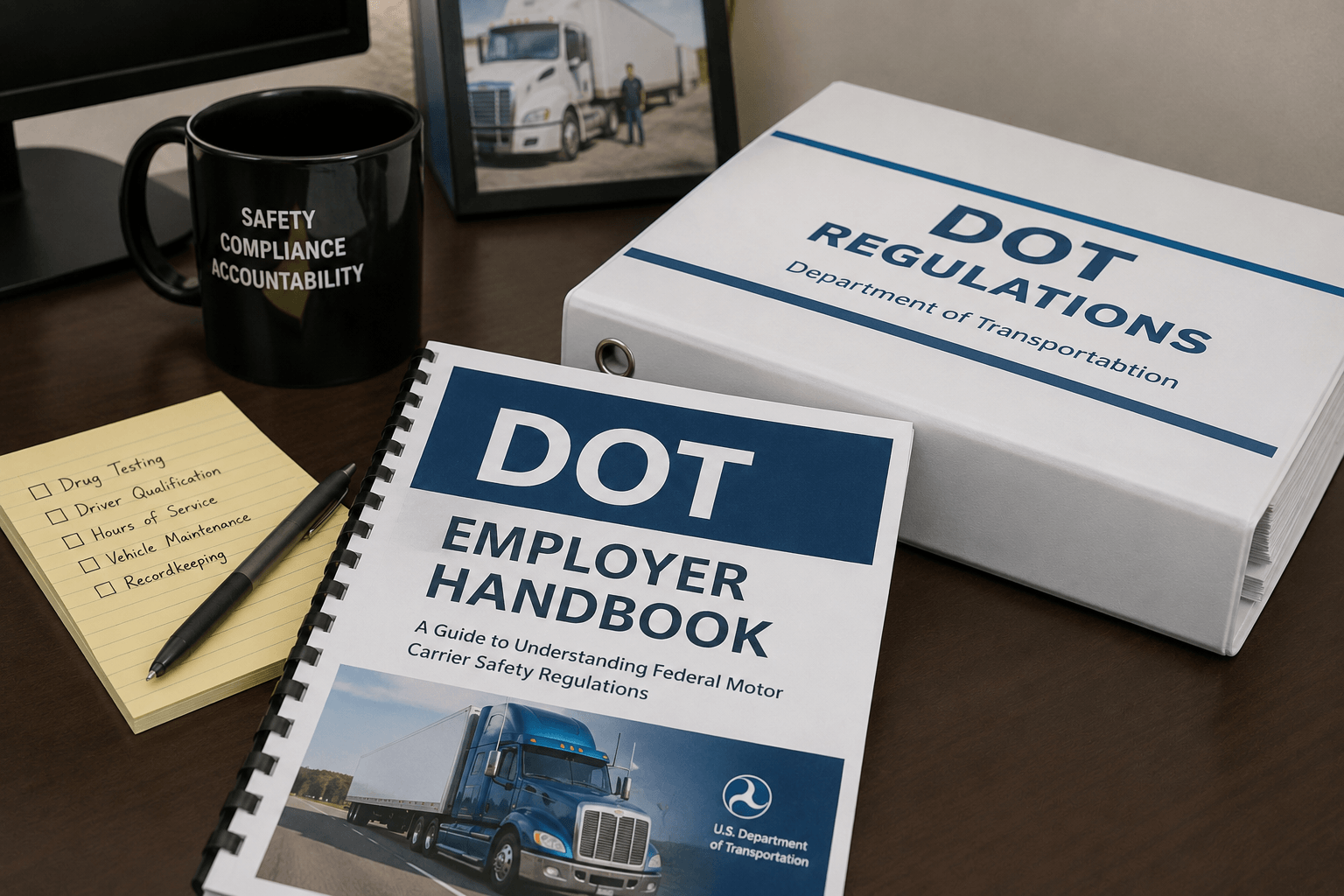
If your company employs commercial truck drivers, airline mechanics, railroad engineers, pipeline controllers, transit workers, or maritime crew, you are operating in one of the most heavily regulated environments in American industry. The Department of Transportation’s Office of Drug and Alcohol Policy and Compliance (ODAPC) published an updated employer handbook in October 2025 — What Employers Need to Know About DOT Drug and Alcohol Testing — and every employer subject to DOT rules needs to read it carefully. At InOutLabs, we help employers navigate exactly these requirements — but first, you need to understand what the handbook actually says.
What Is the DOT Employer Handbook?
The handbook is a comprehensive guidance document published by ODAPC that walks covered employers through every aspect of running a compliant DOT drug and alcohol testing program. Updated as of October 2, 2025, it reflects the latest regulatory requirements — including the addition of oral fluid drug testing to DOT’s program beginning June 1, 2023 (Availability pending as of May 2026) — and provides actionable best practices alongside the strict requirements of 49 CFR Part 40.
The document spans ten sections and six appendices, covering everything from identifying which employees must be tested, to what happens after a violation, to record-keeping and audit preparation. You can download the full handbook directly from transportation.gov. Not sure if your company is covered? Use the DOT’s official “Am I Covered?” decision tool to find out.
Whom This Applies To
The handbook covers employers regulated by FMCSA (motor carriers), FAA (aviation), FRA (railroad), FTA (public transit), PHMSA (pipeline), and the U.S. Coast Guard (maritime). If any of your employees hold safety-sensitive transportation roles, DOT drug and alcohol testing rules apply to you.
10 Reasons You Cannot Afford to Skip This Handbook
- 1
Ignorance of the Rules Is Not a Defense
DOT compliance inspectors and auditors will not accept “we didn’t know” as justification for program failures. The handbook makes the rules explicit — reading it removes any gray area. The ODAPC FAQ page is another resource where inspectors expect covered employers to be current.
- 2
Oral Fluid Testing Changes Your Written Policy
As of June 2023, oral fluid testing is officially part of the DOT program. If your policy still references only “urine specimens,” it should be updated. The handbook explains exactly what decisions you must make.
- 3
Your DER Must Be an Actual Employee
Many employers don’t realize that the Designated Employer Representative (DER) — the person who receives test results and removes employees from safety-sensitive duties — must be a company employee, not a contractor or service agent. Only C/TPAs acting for owner-operators are an exception. See 49 CFR Part 40 for the full definition.
- 4
You Are Responsible for Your Service Agents
Even if you outsource testing to a C/TPA, you remain legally accountable for their compliance. The handbook is unambiguous: take a “hands-on” approach and never assume a service agent is doing everything right.
- 5
Pre-Employment History Checks Are Mandatory
Before a new hire enters a safety-sensitive role, you must request their DOT drug and alcohol testing history going back two, three, or even five years depending on your industry. FMCSA-regulated employers must query the FMCSA Drug & Alcohol Clearinghouse before a CDL driver’s first day and annually thereafter.
- 6
Supervisor Training Has Specific Requirements
Supervisors who oversee safety-sensitive workers must complete one hour of training on indicators of probable drug use and one hour on probable alcohol misuse. This must be documented. The FMCSA employer resources page links to supervisor training guides. InOutLabs offers DOT-compliant supervisor training that satisfies these requirements.
- 7
Refusal to Test Is a Violation — and It’s Broader Than You Think
The definition of “refusal to test” includes behavior at the collection site that may not be obvious — such as an employee failing to cooperate with collection procedures or leaving before a test is complete. Employers and DERs must understand when they are required to make a refusal determination.
- 8
Record-Keeping Requirements Are Extensive — and Audited
The handbook dedicates an entire section to documentation, including what records to keep, how long to keep them, who may access them, and how to respond when inspectors or legal proceedings require them. The DOT provides detailed record-keeping requirement summaries by agency. Gaps in records are a red flag during compliance audits.
- 9
Return-to-Duty Has a Strict, Non-Negotiable Process
Employees who violate DOT drug and alcohol rules cannot simply return to work after a period of time. They must complete a full SAP evaluation, education and/or treatment program, pass a return-to-duty test, and then undergo unannounced follow-up testing. RTD Process
- 10
Audits and Inspections Are Real — and You Should Be Ready
DOT agency inspectors do conduct program reviews. The handbook includes a detailed appendix (Appendix F) outlining what auditors will examine. Reading it in advance lets you identify and close gaps before an inspector finds them.
“You should take a ‘hands-on’ approach and never assume your service agent will do everything right.”
A Snapshot of What the Handbook Covers
The October 2025 handbook is organized into ten sections. Here’s a quick look at what each one addresses and why it matters for your day-to-day operations. The full text is available on ODAPC’s employer handbook page.
| Section | Topic | Why It Matters |
|---|---|---|
| I | DOT Program Implementation & Regulations | Confirms whether you’re covered and how Part 40 interacts with agency-specific rules (FMCSA, FAA, FRA, FTA, PHMSA, USCG) |
| II | Identifying Employees to Be Tested | Defines exactly which job functions are safety-sensitive across all six transportation industries |
| III | Program Policies & Responsibilities | Explains written policy requirements, the DER role, oral fluid policy updates, and program administration options |
| IV | Selecting & Managing Service Agents | Outlines the roles of collectors, MROs, BATs, SAPs, and C/TPAs — and your accountability for their performance |
| V | Employee & Supervisor Education | Specifies what information must be shared with employees and the mandatory supervisor training hours |
| VI | Prior Testing History | Details the lookback period requirements and consent form specifications before any safety-sensitive hire |
| VII | Drug & Alcohol Testing Requirements | Covers all testing types: pre-employment, random, reasonable suspicion, post-accident, return-to-duty, and follow-up |
| VIII | Employer Actions After Violations | Explains immediate removal, the SAP process, return-to-duty requirements, and how to handle refusals |
| IX | Record-Keeping & Data Collection | Lists retention periods by record type, access controls, and MIS annual report requirements |
| X | Compliance & Inspections/Audits | Prepares employers for what DOT investigators examine during a program review |
Official Government & Research Resources
-
- ODAPC Employer Handbook (October 2025)
- 49 CFR Part 40 — DOT Testing Procedures
- ODAPC “Am I Covered?” Decision Tool
- FMCSA Drug & Alcohol Clearinghouse
- FMCSA Employer Resources & Downloads
- DOT Annual MIS Data Collection & Reporting
- NIH/PMC: Random Drug & Alcohol Testing for Preventing Worker Injury
- NIH Bookshelf: DOT Drug & Alcohol Programs in the Transportation Sector
The High Cost of Getting It Wrong
DOT drug and alcohol testing rules exist for a reason: preventing impaired workers from operating vehicles, aircraft, trains, pipelines, and vessels that put the public at risk. The consequences of a non-compliant program are severe on multiple dimensions.
Regulatory Penalties
DOT agencies have authority to assess civil penalties against employers with non-compliant programs. Depending on the agency and violation, fines can run into tens of thousands of dollars per infraction. More seriously, repeat or egregious violations can jeopardize operating authority. Each agency publishes its own civil penalty guidelines — the FMCSA drug and alcohol testing page is a useful starting point for motor carriers. Most common violations listed here.
Safety and Liability Exposure
If an impaired employee in a safety-sensitive role causes an accident and it is discovered that your testing program had gaps, your liability exposure — both in regulatory proceedings and civil litigation — increases dramatically. A well-documented, properly run program is one of your strongest defenses. Our InOutLabs Program Review can identify documentation gaps before they become liability.
Workforce Disruption
Employees who test positive or are found to have prior unresolved violations cannot perform safety-sensitive functions until they complete the full return-to-duty process. Understanding this process in advance — and communicating it clearly to employees — reduces operational disruption and ensures you’re not inadvertently allowing a prohibited employee to work.
Important: New Hire Background Checks & the FMCSA Clearinghouse
An employee with an unresolved prior DOT drug or alcohol violation is prohibited from working in any safety-sensitive position for any DOT-regulated employer until the SAP process is complete. Motor carrier employers must query the FMCSA Drug & Alcohol Clearinghouse before a CDL driver’s first assignment and at least once annually for current drivers. Failing to check — or allowing someone to work after a 30-day grace period without obtaining prior testing history — is itself a violation. Consent forms must be original, signed, employee-specific, employer-specific, and time-period specific. A blanket release is not acceptable.
What “Best Practices” Actually Means in This Handbook
One of the most valuable aspects of the handbook is that it goes beyond minimum compliance requirements to offer best practices — recommendations from ODAPC that, while not legally mandated, reflect what excellent programs do. For example:
The handbook recommends having a “standing order” in place so collection personnel always know what specimen type to collect under what circumstances, reducing delays and errors at the collection site (pertains to oral fluid testing when it becomes available).
It recommends having multiple DERs to ensure round-the-clock coverage, and suggests monthly or quarterly check-ins with service agents rather than assuming they’re keeping you compliant.
It advises annual refresher training for both employees and supervisors — not just one-time onboarding coverage. The ODAPC List-Serve is another tool all employers are required to subscribe to in order to stay current on rule changes and best practices as they evolve. These are the kinds of program habits that separate employers who barely pass audits from those who run exemplary programs.
For a companion resource aimed at your workforce, ODAPC also publishes What Employees Need to Know About DOT Drug & Alcohol Testing — a plain-language handbook you can distribute to covered employees to satisfy your education and disclosure obligations.
How InOutLabs Can Help
At InOutLabs, we specialize in supporting DOT-regulated employers with compliant, efficient drug and alcohol testing programs. Whether you need to update your written policy for oral fluid testing, verify your DER structure, ensure your service agents meet Part 40 standards, or prepare for a compliance audit, our team understands the handbook inside and out.
We also offer DOT-compliant supervisor training that satisfies the one-hour drug and one-hour alcohol training mandates, with documentation you can produce for any inspector. And if you’re an FMCSA-regulated motor carrier, we can help you register and maintain your obligations with the FMCSA Clearinghouse.
We believe that the best compliance programs aren’t built around fear of inspectors — they’re built around genuine understanding of the rules and a commitment to worker safety. That starts with reading the handbook.
Ready to Review Your DOT Testing Program?
Our compliance specialists can audit your current program against the October 2025 ODAPC guidelines and help you close any gaps — before an inspector finds them.