

Posting a job, reviewing resumes, and extending an offer can feel like a complete hiring process. It isn’t. A resume is a marketing document written by the candidate, about the candidate, and there’s no requirement that it be accurate. Accepting it at face value — without independently verifying who someone is and where they’ve actually been — is a risk most businesses can’t afford to carry.
What Is a Background Check?
A background check is a review of an applicant’s history, typically conducted by a third party, to verify information the candidate has provided and surface anything they haven’t. Depending on the role and what matters most to your business, a background check can include:
- Criminal history and convictions
- Motor vehicle records and driving infractions
- Credit history, where permitted by law
- Education and professional licensing verification
- Employment history and reference checks
- Military service records
Some of this is available through searchable databases. Other pieces — particularly employment verification — often require a live conversation with a former employer or supervisor, which is one reason thorough screening takes real time and expertise to do well.
Why Background Checks Matter
No screening process will produce a perfect candidate, because perfect candidates don’t exist. What a comprehensive background check does is close the distance between what a resume claims and what actually happened — and that distance is exactly where hiring risk accumulates.
Consider a public-facing role where a candidate has a history of violent offenses. That history doesn’t just affect your evaluation of fit — it affects the safety of your employees, your customers, and the public your business serves. Background screening gives you the information to make that call deliberately, rather than by accident.
It’s also worth being precise about when background checks are legally required versus simply prudent. In most general hiring, a background check is not mandated by law. But several industries carry specific, binding screening or recordkeeping obligations — healthcare licensing boards, childcare and education roles, financial services, and DOT-regulated transportation positions, where the federal government mandates specific elements of a driver’s file (motor vehicle record checks, FMCSA Clearinghouse queries, and safety performance history with prior employers under 49 CFR §391.23) even though a full criminal background check isn’t separately mandated by FMCSA itself. Knowing which obligations are mandatory for your industry, and which are best practice, is part of building a defensible hiring program.
5 Reasons to Run a Background Check on Every New Hire
Protect your workplace and the people in it
Health and safety in the workplace starts before day one. If a candidate’s criminal history includes convictions relevant to the work they’d be doing, you want that information before they’re on staff, not after an incident. Background checks let employers evaluate candidates against the specific risks of the role — including whether the candidate is even eligible to work with vulnerable populations — and make staffing decisions accordingly.
Confirm the candidate is actually a fit
Every employer wants confidence in a hiring decision. Verifying employment history and speaking with previous employers gives you a more grounded read on how a candidate actually performed, not just how they describe their own performance. It’s the difference between trusting a narrative and confirming a track record.
Stay compliant with industry and regulatory obligations
Background screening helps employers meet statutory and regulatory responsibilities specific to their industry, and skipping it can expose a company to legal action it has no good defense against. For employers serving vulnerable populations in particular, inadequate screening doesn’t just create legal exposure — it can put the people you’re meant to protect directly in harm’s way.
Reduce exposure to negligent hiring claims
When an employer hires someone without reasonably screening for known risk, and that employee later causes harm, the employer can be sued directly for negligent hiring — a claim distinct from ordinary liability for an employee’s actions. This isn’t a theoretical risk.
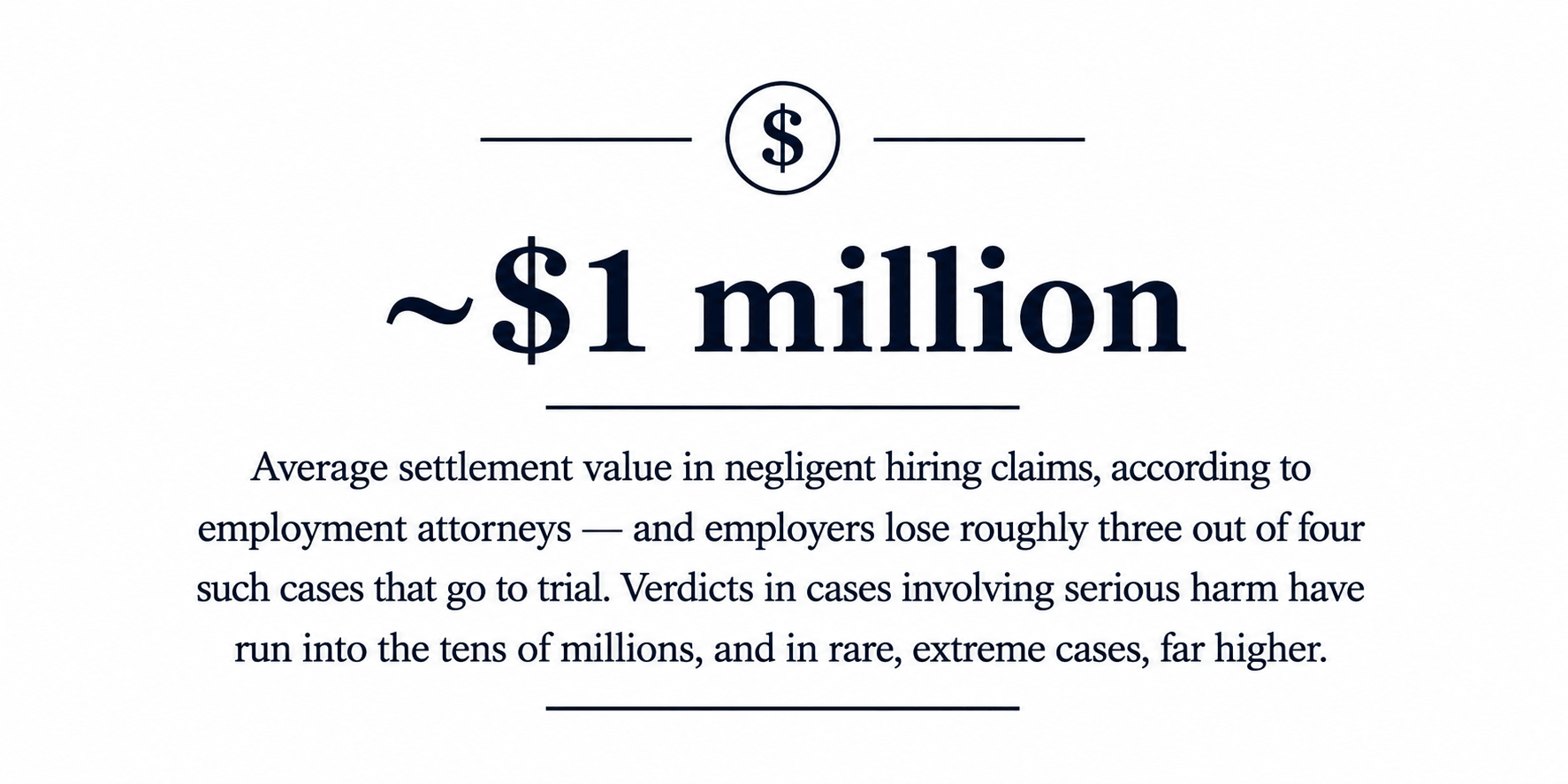
The math is straightforward: a thorough background check costs a fraction of what one negligent hiring claim can cost, and courts in many states treat a documented, good-faith screening process as evidence the employer exercised reasonable care.
Discourage applicants with something to hide
A visible, consistently enforced background check policy tends to filter out candidates who know their history wouldn’t hold up to scrutiny — before you ever have to make that determination yourself. Hiring someone who turns out to be a poor fit doesn’t just cost you that one role; it can ripple into team morale, service quality, customer relationships, and the pace of the company’s growth.
Bringing Screening In-House — Or Letting Someone Else Carry It
Running background checks well takes more than a database subscription. It means staying current on what’s legally permissible to ask and use in your state, knowing which checks are genuinely required for your industry versus which are best practice, and having a consistent, documented process you can point to if a hiring decision is ever challenged.
If that’s more infrastructure than you want to build internally, that’s exactly the gap a dedicated screening partner is built to close.
The Bottom Line
A background check does two things at once: it verifies what’s already on the resume, and it surfaces what isn’t. Both are necessary to make a hiring decision you can stand behind.