
The Federal Motor Carrier Safety Administration’s (FMCSA) Drug and Alcohol Clearinghouse has moved well past its rollout phase. Six years in, it’s doing exactly what it was built to do: keeping a permanent, centralized record of drug and alcohol program violations so a driver can’t simply walk across the street to a new carrier and start fresh. For employers of CDL drivers, that means the Clearinghouse isn’t a one-time setup task anymore — it’s an ongoing compliance obligation with real enforcement teeth.
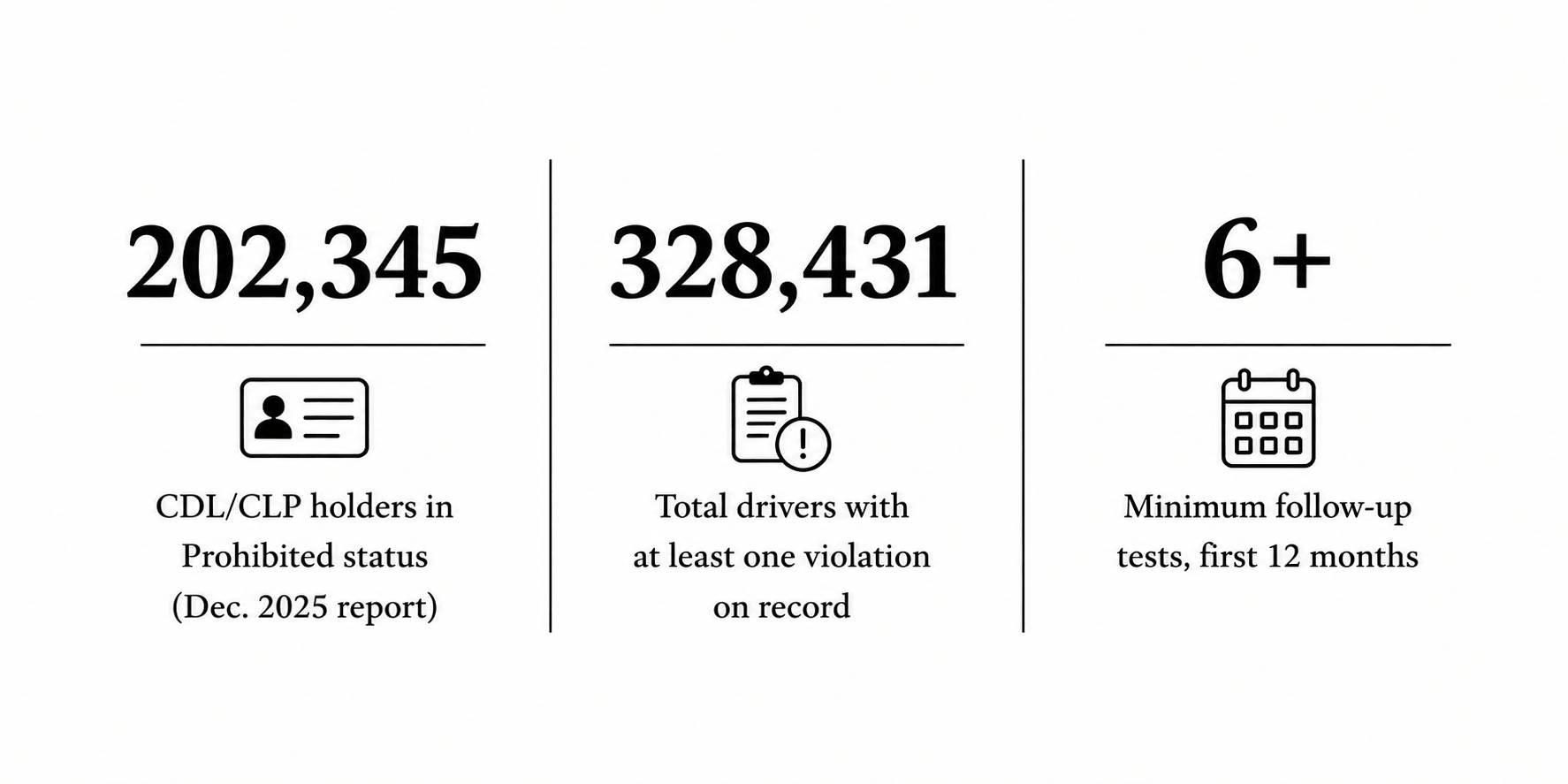
The scale of what the Clearinghouse is catching keeps growing. According to FMCSA’s December 2025 Clearinghouse Monthly Summary Report, 202,345 CDL/CLP holders were in Prohibited status as of the report’s snapshot date of January 2, 2026 — out of 328,431 drivers total who have at least one violation on record. That’s up from roughly 178,000 when state license downgrades first became mandatory in November 2024, and from more than 190,000 by mid-2025 — a steady climb, not a plateau. Of that same violation pool, 159,226 drivers hadn’t even started the Return-to-Duty process yet as of the same report.
A driver in Prohibited status may still physically holds a CDL card, but legally cannot perform any safety-sensitive function — including driving a CMV — until the violation is resolved. That gap between “holds a license” and “legally allowed to drive” is exactly what the second Clearinghouse rule was designed to close.
Clearinghouse II: CDL Downgrades
Under the second Clearinghouse final rule — commonly called Clearinghouse II — State Driver Licensing Agencies (SDLAs) are required to remove the commercial driving privileges from a CDL or CLP when FMCSA notifies them that a driver has a Prohibited status. This requirement became mandatory for all states as of November 18, 2024, the compliance date set in the Clearinghouse II final rule (86 FR 55718).
Key points for employers:
- Drivers in Prohibited status cannot legally operate a CMV, regardless of what their physical license shows. This includes CMVs that do not normally require a CDL.
- SDLAs are required to downgrade the CDL or CLP of any driver FMCSA reports as Prohibited.
- The downgrade stays in place until the driver completes the Return-to-Duty (RTD) process and FMCSA notifies the SDLA the status has changed to “not prohibited.”
- Because the downgrade follows the driver’s license — not their employer — it closes the old loophole where a driver could leave one carrier and start fresh at another without resolving the violation.
One nuance worth flagging for accuracy: the downgrade is triggered by FMCSA’s notification to the SDLA, not automatically the instant a violation is reported. Some states had already been downgrading licenses voluntarily ahead of the 2024 compliance date, so timing can vary slightly by state.
Clearinghouse Queries and MVR Monitoring
Employers regulated under 49 CFR Part 382 are required to query the Clearinghouse in two situations:
- Pre-employment query before allowing a new CDL driver to perform safety-sensitive functions.
- Annual query for every currently employed CDL driver, on a rolling 12-month basis.
If a query — or any other source — reveals an unresolved Clearinghouse violation, the employer must immediately remove that driver from safety-sensitive duties. There’s no grace period built into the regulation for this.
Because CDL downgrades now occur at the state level, a Clearinghouse query alone may not catch every status change in real time. Motor Vehicle Record (MVR) monitoring has become a necessary second layer, since regular MVR checks can surface:
- CDL downgrades processed by the state
- License suspensions or revocations unrelated to the Clearinghouse
- Other license status changes that affect a driver’s eligibility
WHY THIS MATTERS OPERATIONALLY
A driver’s Clearinghouse record and their state-issued CDL status are two different systems that don’t always update in perfect sync. Pairing scheduled Clearinghouse queries with ongoing MVR monitoring closes the visibility gap so a downgrade doesn’t go unnoticed between annual query cycles.
Driver Qualification File management systems and automated MVR monitoring tools can help fleets track both data sources in one place rather than checking them separately. InOut Labs’ related resource site, DriverFileHub.com, covers driver qualification file management and compliance tracking in more depth, including plan and pricing details for ongoing monitoring support.
Return-to-Duty and Follow-Up Testing
A driver with a drug or alcohol program violation cannot return to safety-sensitive functions — and cannot have their CDL downgrade lifted — until they complete the Return-to-Duty (RTD) process. That process requires, in order:
- Evaluation by a DOT-qualified Substance Abuse Professional (SAP)
- Completion of the SAP’s recommended treatment or education plan
- A negative Return-to-Duty drug or alcohol test, observed per DOT collection procedures
- Employer reporting of the RTD test result to the Clearinghouse
Once a driver returns to duty, they’re not done. The SAP determines a follow-up testing plan, and federal regulation sets a floor on what that plan must include:
MINIMUM FOLLOW-UP TESTING REQUIREMENT
At least 6 unannounced follow-up tests in the first 12 months after returning to duty. The SAP has discretion to extend follow-up testing for up to 5 years from the return-to-duty date, depending on the driver’s circumstances.
This is one of the most commonly missed obligations in DOT compliance: the employer — not the SAP — is responsible for making sure follow-up tests actually get scheduled and completed. The SAP sets the plan; carrying it out falls on the employer’s testing program. For a deeper walkthrough of Clearinghouse and RTD obligations, see InOut Labs’ FMCSA Clearinghouse compliance page.
Employer Penalties
Civil penalties for Clearinghouse-related violations fall under 49 CFR Part 382, Subpart G, and are enforced through the penalty schedule at 49 CFR Part 386, Appendix B. Examples of violations that can trigger a penalty include:
- Allowing a Prohibited-status driver to operate a CMV
- Failing to conduct required pre-employment or annual Clearinghouse queries
- Failing to report a violation or an RTD result to the Clearinghouse
- Accessing Clearinghouse records without the driver’s consent
PENALTY AMOUNT — CORRECTED
Civil penalty maximums under Part 382 are adjusted for inflation on a regular basis, and the current maximum runs well above $5,000 per violation — the most recently published penalty schedule places the Part 382 maximum at roughly $7,100 per violation, with additional, separate (and higher) penalty tiers for out-of-service order violations. Always check the current figure in 49 CFR Part 386, Appendix B, since these amounts change with each annual inflation adjustment.
Beyond the civil penalty itself, a Clearinghouse violation found during an audit or post-crash investigation can affect a carrier’s safety rating and increase scrutiny in future FMCSA reviews. Clearinghouse-related findings have consistently ranked among the most common issues identified in FMCSA compliance reviews.
InOut Labs supports DOT-regulated employers with full drug and alcohol testing program compliance, including consortium-based random testing. Learn more on our DOT FMCSA Services page.
Compliance Takeaways for CDL Employers
The data is clear: the Clearinghouse is doing its job of surfacing unresolved violations. Whether it actually keeps unsafe drivers off the road depends on employers holding up their end. At minimum, that means:
- Conducting pre-employment and annual Clearinghouse queries on schedule
- Monitoring MVRs regularly to catch CDL downgrades and suspensions between query cycles
- Removing any driver from safety-sensitive duties immediately upon discovering a violation
- Documenting every step of the Return-to-Duty process
- Tracking and completing every SAP-prescribed follow-up test, not just the required minimum
The system only works as well as the employers operating inside it. Falling behind on any one of these steps doesn’t just create regulatory exposure — it puts an unqualified driver back behind the wheel.