
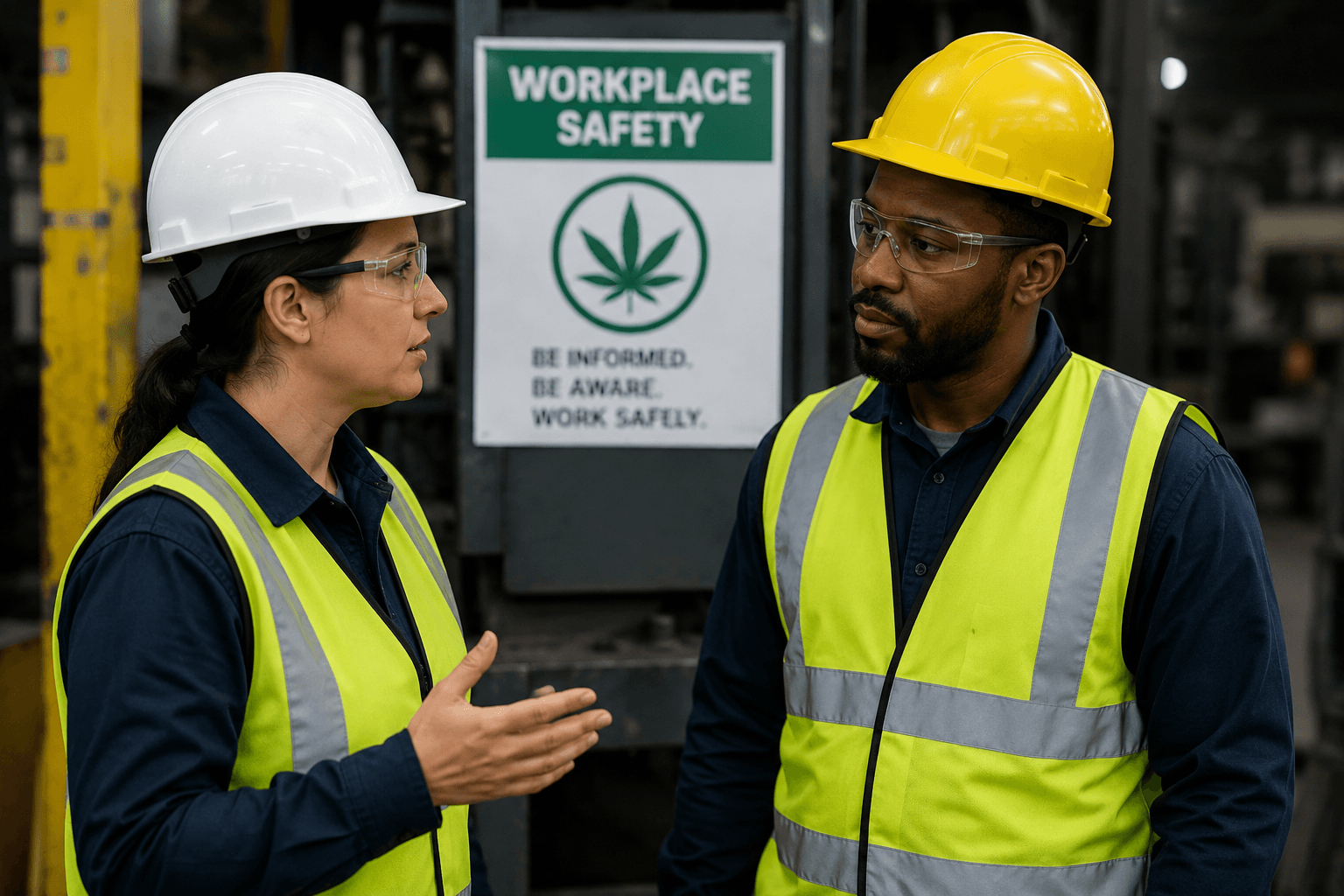
Key Insights
- “Peak impairment often occurs when THC levels have already begun to decline.”
- “Spatial working memory was impaired when measured 22 hours after administration — a full day later.”
Marijuana legalization is spreading rapidly across the United States. As of 2024, over two-thirds of states have legalized recreational and/or medical cannabis. For employers — particularly those managing safety-sensitive workplaces — this shift raises a critical question that science is still working to fully answer: How do you actually know if a worker is impaired?
The answer is more complicated than most drug policies acknowledge. Two concepts that are frequently conflated — marijuana intoxication and marijuana impairment — are not the same thing, and understanding the difference is essential to building policies that are both effective and defensible.
The Core Problem: Detection ≠ Impairment
With alcohol, the relationship between consumption and impairment is well understood. The body metabolizes alcohol at a consistent rate, and blood alcohol concentration (BAC) closely tracks intoxication. A breathalyzer gives employers and law enforcement a reliable, real-time measure of impairment.
Cannabis works entirely differently. THC — the psychoactive compound in marijuana — is fat-soluble and binds to fatty tissue, which means it can be detected in urine, blood, and hair for days or even weeks after use, long after any psychoactive effects have worn off. As the National Institute for Occupational Safety and Health (NIOSH) has stated plainly: since marijuana is stored in fatty tissue, it can be detected through drug testing several days or weeks after use — long after the individual has stopped experiencing any physiological effects or impaired functioning.
Key Finding — NIOSH / CDC
Standard urine drug tests detect the presence of THC metabolites, not active intoxication. A positive test result cannot tell you whether a worker is currently impaired, or whether they used cannabis last night, last week, or three weeks ago.
This distinction has enormous implications for workplace safety policy. As the journal Cannabis and Cannabinoid Research concluded, routine urine testing cannot distinguish between current and prior cannabis use, and is of limited utility in determining whether or not an employee is actually under the influence of cannabis on the job.
Intoxication vs. Impairment: A Critical Distinction
These terms are often used interchangeably, but they describe meaningfully different states — and confusing them leads to flawed policies.
| Concept | Definition | Detectable by Standard Test? |
|---|---|---|
| Intoxication | The subjective “high” — euphoria, altered perception of time and space, relaxation, disinhibition, and cognitive shifts that occur during active THC influence | No — tests detect metabolites, not active THC “high” |
| Impairment | Measurable degradation of specific cognitive or psychomotor functions relevant to job performance and safety — reaction time, spatial reasoning, attention, motor control | No — impairment cannot currently be objectively measured by any scientifically proven, field-ready methodology |
Research consistently shows that these two states do not align neatly. NIOSH has acknowledged that the THC levels that create impairment are not well understood, and that there is wide variability in how THC is metabolized by frequent users versus infrequent users — which makes interpretation of a positive drug test a significant challenge.
“Simply detecting any THC does not indicate impairment.” — AAA Foundation for Traffic Safety (cited in NHTSA)
A U.S. National Highway Traffic Safety Administration report reached the same conclusion, noting that most studies have found that levels of THC do not closely correlate to the degree of impairment — and that peak impairment often occurs when THC levels have already begun to decline.
Adding further complexity: tolerance plays a significant role. Research published on PMC via NIH found that frequent cannabis users demonstrated significantly less acute impairment across several neuropsychological tests compared to occasional users following the same THC dose — a direct consequence of tolerance. The subjective feeling of being “high” may fade faster than actual cognitive deficits in some users, while in others, cognitive function may remain largely intact despite regular use.
The Day-After Problem: THC and Spatial Discrimination
Perhaps the most overlooked dimension of cannabis and workplace safety is what happens the following day. The assumption that a worker who used cannabis the night before is fine by morning is not well supported by the evidence.
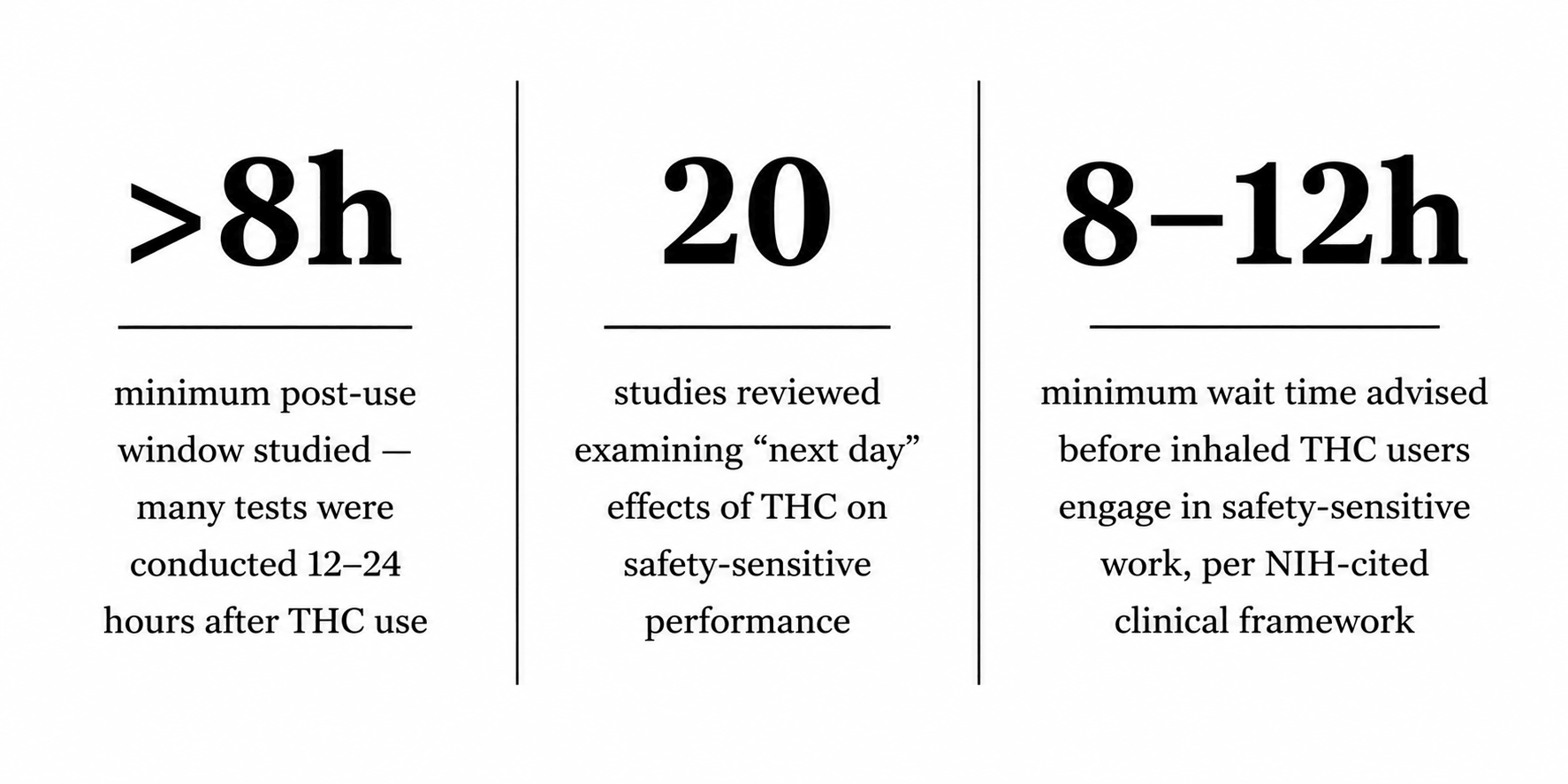
A systematic review published in Cannabis and Cannabinoid Research (NIH/PMC) examined 20 studies involving nearly 460 participants, reviewing 345 performance tests conducted more than 8 hours after THC use. The review was designed specifically to investigate whether THC impairment persists well after the intoxication period ends — a direct question of significance for safety-sensitive workplaces.
One area of particular concern is spatial cognition. Multiple lines of research converge on the finding that THC has a notably specific effect on the brain’s ability to process spatial information — the type of reasoning needed to navigate physical environments, operate machinery, judge distances, and perform tasks requiring awareness of one’s position in space.
Research published in PubMed/NIH found that while THC did not affect color discrimination performance, spatial memory was significantly impaired — and researchers concluded that the effect of THC on spatial learning appeared to be specific rather than a general function of sedation or motor disruption, since neither motor activity nor anxiety-related behavior was influenced by the drug treatment.
Studies in chronic THC administration, also published via NIH’s PMC, found that spatial working memory was impaired when measured 22 hours after administration — a full day later — while tolerance or sensitization to these specific effects did not reliably develop over time. In other words, daily users did not necessarily adapt to these residual spatial deficits the way they may adapt to feeling “high.”
Workplace Safety Implication
Spatial discrimination is a core competency for workers operating forklifts, heavy machinery, vehicles, scaffolding, and complex assembly lines. If THC use the evening before a shift can measurably degrade spatial memory and working memory the following morning — even after the subjective “high” has passed — standard pre-shift protocols may fail to catch meaningful impairment.
A clinical framework for assessing cannabis-related impairment risk, published in Frontiers in Psychiatry (PMC/NIH), recommends waiting at least 8–12 hours after inhaled cannabis use — and at least 12 hours after ingested cannabis — before engaging in safety-sensitive positions. The review notes that oral cannabis products (edibles) have longer and less predictable durations of action, which may require even stricter restrictions for workers in hazardous environments.
Why Current Drug Testing Falls Short
Given these complexities, it is worth being direct about what standard workplace drug testing can and cannot do:
What a positive marijuana test tells you
That the worker was exposed to cannabis at some point — potentially days or weeks ago. It does not establish when, at what quantity, or whether any meaningful impairment exists at the time of testing.
What a positive marijuana test does NOT tell you
Whether the worker is currently impaired. Whether the worker was impaired at the time of an incident. Whether the worker will be impaired on their next shift. What their level of tolerance is. Whether they are a medical cannabis patient managing a legitimate condition.
As research published in PMC notes, there is currently no practical, accurate, and timely test for determining cannabis intoxication analogous to the breathalyzer for alcohol. Plasma THC measurement is the most accurate available method and does correlate with degree of impairment in a more linear fashion — but it requires blood draws, laboratory processing, and clinical interpretation, making it impractical for routine field use.
The research literature is clear that when assessing the potential implications for workplace safety, it is critical to distinguish between cannabis use and cannabis impairment or intoxication — and that not all individuals who consume cannabis before work will be impaired, particularly among medical cannabis consumers using lower-THC products or frequent users who have developed considerable tolerance.
What Forward-Looking Employers Are Doing
Given the gap between what current testing can measure and what safety actually requires, progressive workplace safety programs are shifting their approach. Rather than relying solely on urinalysis, they are building multi-layered strategies that focus on observable performance rather than assumed impairment from prior use.
Behavioral observation training
Supervisors are trained to recognize specific, documented signs of impairment — slowed reaction, disorientation, impaired coordination, confusion about spatial location — rather than relying on a positive test result from days or weeks ago. Clinical research identifies objective signs such as elevated heart rate, altered time perception, impaired concentration, and disorientation as markers of active cannabis intoxication.
Performance-based fitness-for-duty testing
Computerized cognitive and psychomotor tests — administered at the start of a shift and compared against an individual’s own baseline — can detect impairment regardless of cause, whether from cannabis, alcohol, prescription medications, fatigue, or illness. These systems measure what matters: actual performance.
Clear off-hours use policies
Given that residual effects on spatial cognition may persist 12 or more hours after use, clear policies that establish minimum windows between cannabis use and safety-sensitive work — informed by the clinical guidance of 8–12 hours for inhaled and 12+ hours for ingested cannabis — give employees clear, defensible expectations.
Medical cannabis accommodation reviews
As courts in multiple jurisdictions have ruled that a positive drug test alone — without evidence of actual impairment at work — is not sufficient grounds for adverse employment action, employers should work with legal counsel to develop accommodation review processes for medical cannabis patients.
The Bottom Line for Safety-Conscious Employers
The science is clear on several things: marijuana impairment and marijuana intoxication are not synonymous. A drug test cannot establish either one with precision. And THC’s effects on spatial cognition — one of the cognitive functions most critical to physical safety on a job site — can extend well beyond the hours when a person subjectively feels “high.”
Building a workplace safety program that truly protects workers requires moving beyond the blunt instrument of urinalysis toward systems that measure actual, real-time performance. The goal is not to accommodate impaired workers — it is to accurately identify them. And right now, a positive drug test alone cannot reliably do that.
InOutLabs is committed to helping employers navigate this evolving landscape with testing solutions, training resources, and policy frameworks grounded in current science. Contact our team to learn how our fitness-for-duty and behavioral observation programs can strengthen your workplace safety strategy.
References
- NIOSH/CDC. Cannabis and Work: Implications, Impairment, and the Need for Further Research. NIOSH Science Bulletin, 2020. cdc.gov
- McCartney D, Suraev A, McGregor IS. The “Next Day” Effects of Cannabis Use: A Systematic Review. Cannabis Cannabinoid Res. 2023;8(1):92–114. PMC9940812. pmc.ncbi.nlm.nih.gov
- Costiniuk CT, et al. Cannabis and Cognitive Functioning: From Acute to Residual Effects, From Randomized Controlled Trials to Prospective Designs. PMC8222623. pmc.ncbi.nlm.nih.gov
- Ware MA, et al. A Clinical Framework for Assessing Cannabis-Related Impairment Risk. Front Psychiatry. PMC9272752. pmc.ncbi.nlm.nih.gov
- Berning A, et al. Workplace Cannabis Policies: A Moving Target. PMC8864412. pmc.ncbi.nlm.nih.gov
- Cross-sectional analysis of cannabis use at work in the USA. PMC12323537. pmc.ncbi.nlm.nih.gov
- Kolb B, et al. Acute administration of THC impairs spatial but not associative memory function in zebrafish. PubMed 24639045. pubmed.ncbi.nlm.nih.gov
- Kangas BD, et al. Chronic Δ9-THC in Rhesus Monkeys: Effects on Cognitive Performance. PMC5774214. pmc.ncbi.nlm.nih.gov
- Bhattacharyya S, et al. Cannabis use and cognitive dysfunction. PMC3221171. pmc.ncbi.nlm.nih.gov
- Lorenzetti V, et al. The effect of cannabis use on memory function: an update. PMC3931635. pmc.ncbi.nlm.nih.gov