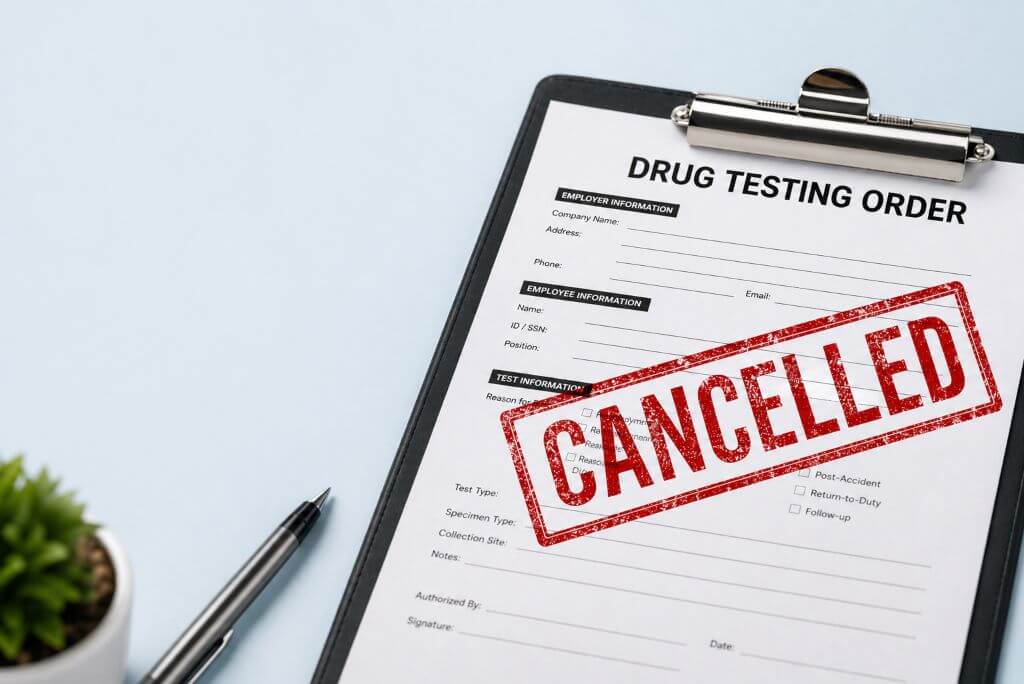
If you manage a DOT-regulated workforce, you’ve probably encountered a cancelled drug test at some point — and wondered what to do next. A cancelled result can feel like a dead end, but it’s actually the beginning of a process that requires careful attention. Here’s what you need to know.
A Cancelled Test Is Not Negative. Or Positive.
The first thing to understand: a cancelled DOT drug test is neither a positive nor a negative result. It doesn’t clear the employee, and it doesn’t count as a violation. But it’s also not simply a “no result” that you can ignore. Depending on the reason for cancellation, specific follow-up steps may be required of the employer and/or the Designated Employer Representative (DER).
Why Does an MRO Cancel a DOT Drug Test?
A Medical Review Officer (MRO) may cancel a DOT drug test for several reasons:
- Fatal Flaws — Errors in the collection or documentation process so serious they cannot be corrected [49 CFR 40.199]
- Correctable Flaws that were never corrected — Errors that could have been fixed, but weren’t within the required timeframe [40.203]
- Invalid Laboratory Results — The specimen produced a result the lab could not verify as a valid human urine sample [40.159]
- Split Specimen Issues — Problems with the secondary specimen that affect the integrity of the result [40.187(b)(c)(e)]
- Shy Bladder with a Valid Medical Explanation — When a donor can’t provide an adequate specimen and a physician confirms a legitimate medical reason [40.193(d)]
Each of these scenarios carries its own set of requirements — and consequences. For a deeper look at invalid results specifically, see our post on Invalid Drug Test Results: Causes and Next Steps.
Fatal Flaws and Uncorrected Errors
When a test is cancelled due to a fatal flaw or a correctable flaw that was never resolved, the MRO reports the cancellation along with the reason. In most cases, no further action is required — unless the test was a pre-employment, return-to-duty, or follow-up test. In those situations, a new negative result must be obtained before the employee can proceed.
It’s also worth noting that certain triggering events — like a workplace accident — carry their own testing requirements independent of the result. If you manage FMCSA-regulated drivers, our post on what happens when an employer fails to conduct post-accident testing is essential reading.
Invalid Results: The Most Complex Scenario
Invalid lab results trigger a more involved process. The MRO is required to attempt contact with the employee to discuss the result. From there, the outcome depends on what the MRO learns. (Curious how this process works for non-DOT tests? See our post on the Medical Review Process for Non-DOT testing.)
No Further Action Required
If the employee provides an acceptable explanation for the invalid result, the MRO cancels the test and advises the DER that no further action is needed — again, unless a negative result is required for pre-employment, return-to-duty, or follow-up purposes [40.159(a)(4)].
Immediate Direct Observation Collection Required
If the MRO cannot reach the employee, or if the employee provides no acceptable explanation and denies adulteration, the MRO will instruct the DER to send the employee for an immediate re-collection under direct observation [40.159(a)(5)]; [40.133(b)]. The employee must receive the minimum possible advance notice before reporting to the collection site.
Employer tip: Reach out to the collection site in advance to confirm they can perform an observed collection. This prevents delays once the employee arrives.
Refusal to Test
If the employee admits to adulterating or substituting the specimen during the MRO interview, the result is reported as a Refusal to Test [40.159(c)]. This is treated the same as a positive test under DOT regulations, and the employer must take appropriate action under the relevant DOT agency rules.
Test Cancelled — Admission of Use
If the employee admits to using a drug during the MRO interview, the MRO cancels the test but documents the admission [40.159(d)]. The employer is then responsible for taking appropriate action under the applicable DOT agency regulations.
Key Takeaways for Employers and DERs
- Don’t assume a cancelled test means “move on.” Always confirm with your MRO whether further action is needed.
- Pre-employment, return-to-duty, and follow-up tests require a valid negative result — a cancellation alone doesn’t satisfy that requirement.
- When an immediate direct observation re-collection is ordered, act quickly and coordinate with the collection site before sending the employee.
- Admissions made during an MRO interview — whether about drug use or specimen tampering — have serious regulatory consequences.
- Not sure whether your testing program falls under DOT rules? Review our breakdown of DOT vs. Non-DOT drug testing to make sure you’re following the right framework.
- For a comprehensive overview of the federal rules that govern all of this, bookmark our DOT Testing Program Resources page.
Have Questions About a Cancelled DOT Drug Test?
Navigating MRO results can be confusing, especially when the situation involves direct observation collections or employee admissions. The team at In Out Labs is here to help you understand your obligations and next steps.
Contact us today or visit inoutlabs.com to learn more about our DOT-compliant drug testing services.
This post is for informational purposes only and is based on 49 CFR Part 40 regulations. Always consult your MRO or a qualified compliance professional for guidance specific to your situation.