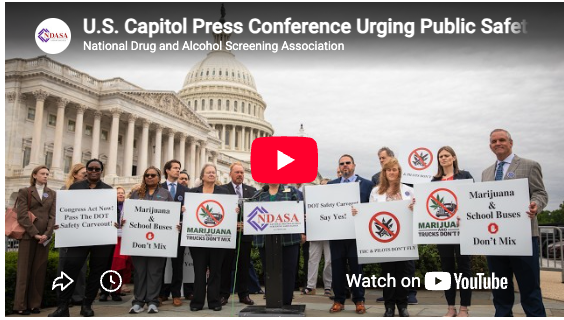
Science doesn’t change with a scheduling decision. Impairment is impairment — and when you’re behind the controls of a plane or an 80,000-pound truck, that’s a matter of life and death.
 Tim Thoelecke, CSAPA, InOut Labs
James Greer (Past Chairman, National Drug and Alcohol Screening Association)
Opened the conference by warning that rescheduling marijuana from Schedule 1 to Schedule 3 could eliminate the federal government’s ability to test safety-sensitive transportation workers — including pilots, truck drivers, school bus drivers, and air traffic controllers — for THC. He called on Congress to pass a “safety carveout” to preserve DOT’s authority to continue marijuana testing.
Congressman Andy Harris (Maryland's 1st Congressional District)
Endorsed NDASA’s call for a safety carveout, arguing the American public deserves assurance that transportation workers are not impaired by marijuana. He framed it as a clear, common-sense “red line” and pledged to advocate for the measure in Congress.
Mark Magsum (Chairman, NDASA)
Congressman Pete Sessions
Jo McGuire (Executive Director, NDASA)
Heidi Morrison (Survivor, 1987 Chase, Maryland Train Crash)
Delivered the most personal testimony of the conference, recounting the January 4, 1987 collision between an Amtrak passenger train and a Conrail train in Chase, Maryland — the worst crash in Amtrak history. Sixteen people died and 170 were injured. The NTSB determined the cause was marijuana impairment of the two Conrail engineers, who admitted to smoking marijuana in the cab before and during operation. She argued that the DOT drug testing program instituted after that crash has prevented any similar marijuana-caused accident since, and urged Congress to protect that program.
Patrice Kelly (Former Director, DOT Office of Drug and Alcohol Policy and Compliance)
Brought 35 years of federal expertise to explain the legal mechanism creating the crisis. President Reagan’s 1986 executive order granted HHS authority to test for Schedule 1 and 2 substances only. Moving marijuana to Schedule 3 would remove it from HHS jurisdiction, and since a 1991 law requires all DOT testing to use HHS-certified labs and guidelines, DOT would lose the ability to test for marijuana entirely. She noted that drug testing achieves 98% deterrence among safety-sensitive workers and called the safety carveout an urgent, nonpartisan necessity.
Angela Moore (Synergy, speaking for the American Association of Medical Review Officers)
Patrice Kelly (Former Director, DOT Office of Drug and Alcohol Policy and Compliance)
Dr. Ben Gerson (Medical Review Officer Certification Council)
Reinforced that the neurological effects of THC do not change regardless of its legal classification. He warned that removing clear testing pathways would create confusion for employers, employees, and MROs, and could inadvertently signal that marijuana poses no workplace safety risk — a message unsupported by science. He emphasized that drug testing is about prevention, not punishment.