
DOT drug testing violations are the most common reason FMCSA penalizes motor carriers. If FMCSA closes an enforcement case against your company, there is about a 2-in-5 chance it cites a violation of 49 CFR Part 382, the federal drug and alcohol testing rules for CDL drivers.
We reviewed 12,835 closed FMCSA enforcement cases from January 2022 through September 2026. 5,211 of them (41%) included at least one Part 382 violation, and those carriers paid a combined $44.97 million in settlements.
Testing violations are not paperwork technicalities. Part 382 is cited in more closed cases than any other part of the FMCSRs. It appears in 5,211 cases, compared with 3,256 for hours of service (Part 395) and 2,549 for inspection and maintenance (Part 396). Below we show what the data says, which violations cost the most, and what to fix before an investigator finds it first.
DOT drug testing penalties are rising, not easing
The typical Part 382 settlement increased from a median of $6,215 in 2022 to $7,090 in 2024 and $7,230 so far in 2026. The average settlement is now above $9,000.
The share of cases holding steady matters just as much. Part 382 was cited in 40–42% of closed cases in every full year from 2022 through 2024, at roughly 1,500 cases a year. This is a steady, predictable enforcement priority, not a one-time crackdown.
A testing violation also raises the price of the whole case. Cases with a Part 382 citation settled for a median of $7,020, compared with $3,940 for cases without one, close to double.
Which Part 382 violations cost the most
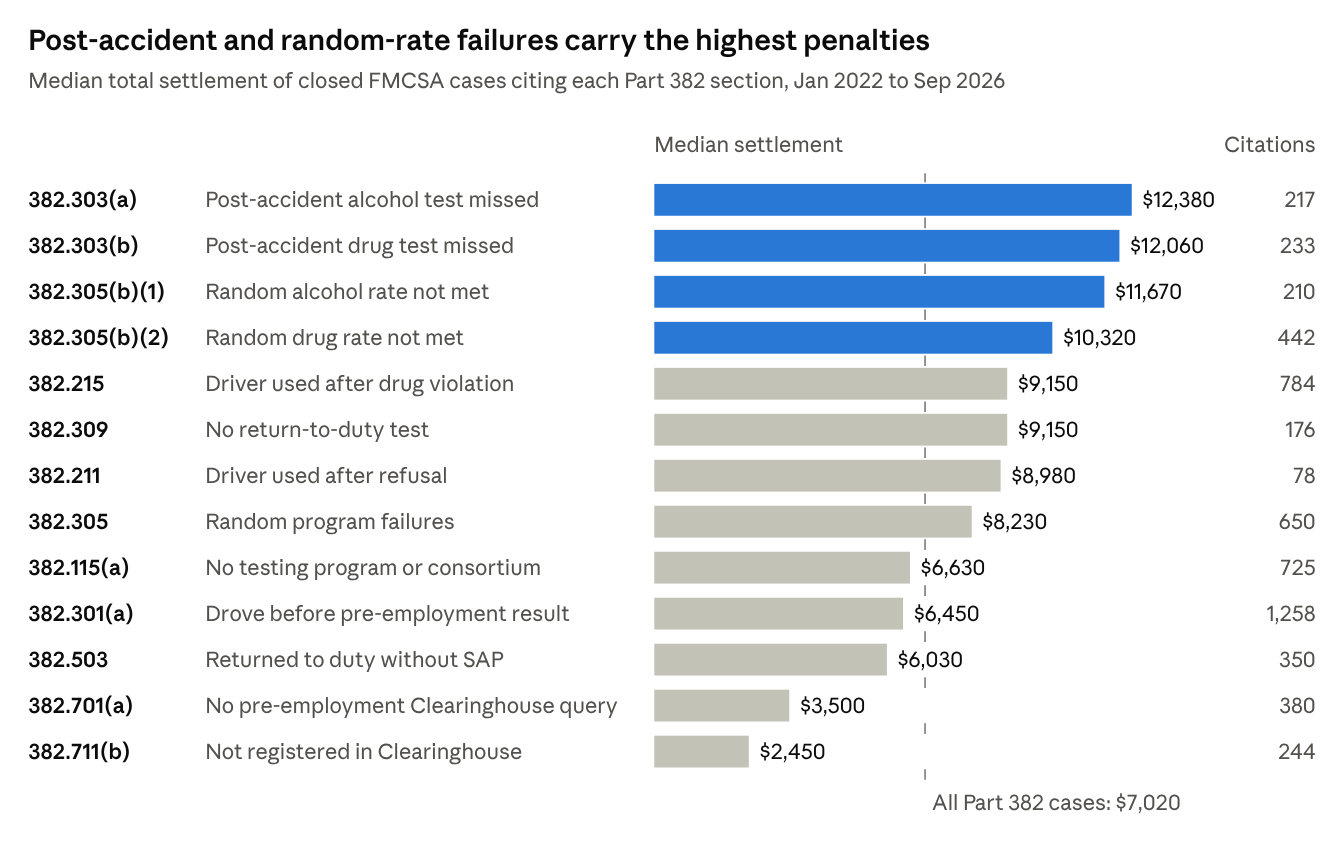
FMCSA closed enforcement cases, Jan 2022 to Sep 2026 · median of each case’s total settlement; one case can cite several sections.
The most common citation is the simplest to avoid: 382.301(a), putting a driver to work before a negative pre-employment result is on file, cited 1,258 times. Close behind are not having a testing program at all (725 citations) and random program failures (650).
The most expensive citations are post-accident testing failures and missed random rates, with median settlements of $10,000 to $12,400. Clearinghouse violations settle for less, around $2,500 to $3,500. They are also among the easiest violations for an investigator to confirm, because FMCSA can see your query history directly.
One drug testing violation opens the whole file
Only 3,307 of the 5,211 cases (63%) cited Part 382 alone. In the rest, the investigator kept looking and found more. The violations most often cited alongside Part 382 were:
- 383.37(a): allowing an unqualified CDL driver to operate. Cited in 670 cases. Often it’s the same driver who was never tested, never queried, or never cleared to return to duty.
- 395.8: hours-of-service records. About 790 citations across its subsections.
- 391.51: driver qualification files. About 400 citations.
- 396.3: inspection, repair and maintenance. About 420 citations.
The pattern is clear. A carrier that lets testing slide rarely has everything else in order, and FMCSA knows it. One missing pre-employment result can be the thread that leads to the driver files, the ELD logs and the maintenance records.
The largest FMCSA drug testing settlements
Most Part 382 cases settled between $2,500 and $20,000, but 319 cases went above $20,000 and 18 went above $50,000. In nearly every one of the ten largest, the violations involve random testing, post-accident testing, return-to-duty testing, or a driver kept on the road after a positive test or refusal.
| Carrier | State | Year closed | Violations cited | Settled |
|---|---|---|---|---|
| Standard Forwarding LLC | IL | 2023 | 382,305(b)(2); 383.37(a) | $135,390 |
| DMG Consulting & Development, Inc. | IL | 2023 | 382.215; 383.37(a); 392.2; 395.3(a)(3)(i) | $97,990 |
| W. O. Grubb Steel Erection Inc. | VA | 2024 | 382.305(b)(2); 382.309 | $85,230 |
| Highway Freight Systems Inc | PA | 2024 | 382.301(a); 382.305(b)(1)/(b)(2); 383.37(a); 395.8(e)(1); 396.3(a) | $84,590 |
| LB Independent Corp | IL | 2024 | 382.303(a); 392.2; 395.8(e)(1); 396.11(a) | $75,870 |
Standard Forwarding’s $135,390 settlement rested on only two violations: falling short of the random testing rate and using an unqualified driver.
By case count, the most active states were Texas (594), California (424), New Jersey (314), Florida (253) and Georgia (231). Illinois had 172 cases but accounted for five of the ten largest settlements.
DOT drug and alcohol testing compliance checklist
Every item below lines up with a violation that appears hundreds of times in FMCSA’s closed cases. If you can’t answer “yes” to each one with documents in hand, you have exposure.
- Enrolled in a compliant testing program or consortium (382.115). Your owner-operators count too.
- A verified negative pre-employment drug result on file before each driver’s first safety-sensitive function (382.301), not just a scheduled collection.
- A full pre-employment Clearinghouse query for every new CDL driver (382.701(a)), plus annual queries for every current driver (382.701(b)).
- An active Clearinghouse registration (382.711), with a designated C/TPA if you use one.
- Random selections that meet FMCSA’s minimum annual rates, currently 50% for drugs and 10% for alcohol. Selections must be spread reasonably through the year, and every selected driver must be tested promptly (382.305).
- Post-accident testing on every qualifying crash, with documentation if a test could not be done in time (382.303).
- No driver back behind the wheel after a positive test or refusal until the SAP process and a negative return-to-duty test are complete (382.215, 382.503, 382.309).
- Follow-up testing carried out on the SAP’s schedule (382.311).
- Supervisors trained in reasonable suspicion (382.603), with records you can produce.
Don’t wait for an audit to show you which item is missing. Running this list against your own records takes an afternoon. Citations for missing the random testing rate carried median settlements above $10,000.
Frequently asked questions about DOT drug testing violations
What is the most common DOT drug testing violation?
The most common one is 382.301(a): letting a driver perform safety-sensitive work before the carrier has a verified negative pre-employment drug test result. It was cited 1,258 times in FMCSA closed cases from 2022 to 2026.
How much is the fine for a DOT drug testing violation?
Across 5,211 closed FMCSA cases citing Part 382, the median settlement was $7,020 and the average was $8,630. Post-accident and random-rate violations had medians above $10,000, and 18 cases settled for more than $50,000.
Does FMCSA check Clearinghouse compliance?
Yes. Missing pre-employment queries (382.701(a)) and failing to register (382.711(b)) were cited more than 600 times combined. They are easy for FMCSA to confirm because query activity is recorded in the Clearinghouse.
Do owner-operators need a DOT drug testing program?
Yes. An owner-operator with a CDL must be in a random testing pool through a consortium/third-party administrator (C/TPA) and must register in the Clearinghouse. Not having a testing program (382.115(a)) was cited 725 times.
Avoid DOT drug testing violations with an experienced C/TPA
The compliance cost is a fraction of the penalty. InOut Labs is a national C/TPA, and we run DOT drug and alcohol testing programs for motor carriers in all 50 states. Our services include consortium enrollment, random pool administration, Clearinghouse queries and reporting, MRO and SAP coordination, and supervisor training.
If any item on the checklist above made you pause, contact InOut Labs for a program review before FMCSA does one for you.