How to Build an Effective Drug Testing Program for Remote and Multi-Location Employees
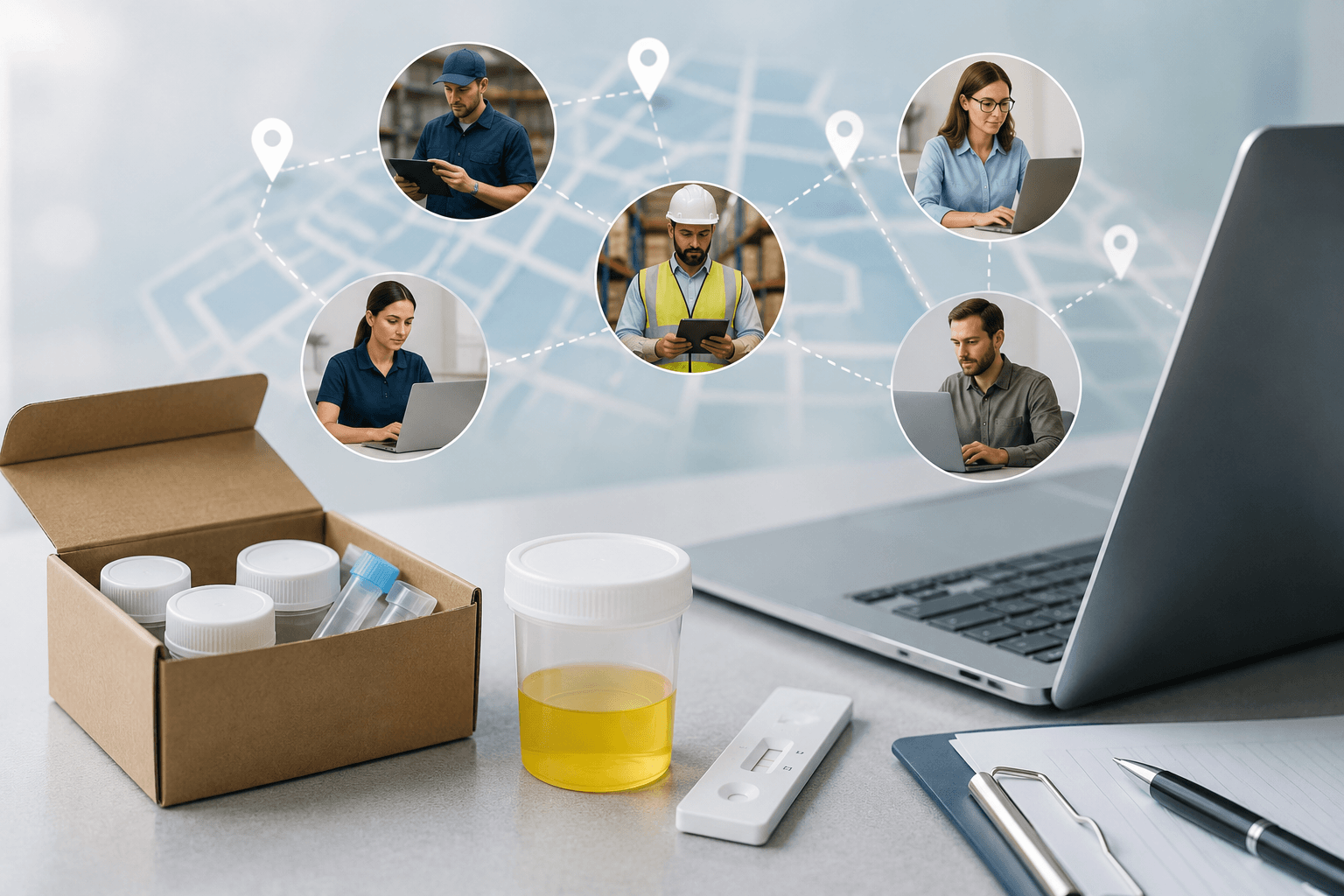
Remote work and multi-state operations have changed how employers manage almost everything — including drug and alcohol testing. When your workforce is spread across cities, states, or even time zones, the old model of “send everyone to the same clinic down the street” simply doesn’t work anymore.
The good news: with the right third-party administrator (C/TPA) and the right technology, a dispersed workforce is no harder to test than a single-site one — it just requires a different approach. This guide covers why testing programs matter, the specific challenges dispersed workforces create, and the strategies that make them manageable at scale.
Why Drug Testing Programs Matter
- Safety. Impaired employees are more likely to cause accidents, injuries, and near-misses — a risk that doesn’t disappear just because someone works from a home office or a satellite location.
- Productivity. Substance use is linked to higher absenteeism, more errors, and lower overall output.
- Regulatory compliance. Employers in safety-sensitive industries — transportation, aviation, pipeline, maritime, and others — are required to test under federal regulations (49 CFR Parts 40, 382, and other modal rules). Non-compliance carries real financial and legal exposure.
- Reduced liability. A documented, consistently applied testing program is one of an employer’s strongest defenses if an accident or injury does occur.
What Makes Dispersed Workforces Harder to Test
Before jumping to solutions, it’s worth naming the specific problems a spread-out workforce creates:
- Collection site coverage. You need a lab or collection site within a reasonable distance of every employee — not just your headquarters city.
- Consistency across locations. Different clinics, different chain-of-custody handling, different turnaround times can all introduce variability that undermines your program.
- Scheduling logistics. Coordinating random selections, post-accident tests, and reasonable suspicion tests gets harder when there’s no local HR person to physically walk an employee to a clinic.
- Policy uniformity. DOT-regulated employers, in particular, must apply testing policy identically regardless of an employee’s location — you can’t have a stricter or looser standard for the remote office.
Strategies for Managing a Dispersed Testing Program
1. Choose a Provider Built for Nationwide Coverage
Not every collection agency or lab network can support employees in 50 states. Look for a provider with:
- A nationwide network of collection sites (so employees aren’t driving an hour to test)
- Certified C/TPA status and experience specifically with dispersed or remote workforces
- The ability to order a test anywhere in the country from a single account, rather than juggling multiple regional vendors
InOut Labs’ ordering portal (drugtest.inoutlabs.com) lets employers schedule a test near any employee, in any state, from one login — no separate accounts or regional vendors to manage.
2. Put Technology Between You and the Chaos
Manual scheduling and paper chain-of-custody forms don’t scale across locations. Look for a platform that offers:
- Web-based test ordering and scheduling
- Real-time result tracking and reporting from a single dashboard
- Electronic chain-of-custody where available, to reduce lost paperwork and delays
3. Write One Policy — Apply It Everywhere
Your written policy should specify testing triggers (pre-employment, random, reasonable suspicion, post-accident, return-to-duty, follow-up), consequences for refusal or a positive result, and the procedure for each. For DOT-regulated positions, this policy must comply with 49 CFR Part 382 (or the applicable modal rule under FRA, PHMSA, or USCG) and cannot vary by location. For non-regulated employers, consistency still matters — a policy applied unevenly across sites is difficult to defend if challenged.
4. Communicate and Train — Especially Supervisors
Employees need to understand what’s expected of them regardless of where they sit. Supervisors need it even more: DOT rules require at least 60 minutes of reasonable suspicion training on alcohol and 60 minutes on drugs for anyone who supervises safety-sensitive employees. In a remote environment, that training is what allows a supervisor to recognize and act on signs of impairment they’d otherwise never see in person.
5. Don’t Let Random Selection Slip Through the Cracks
Random testing pools are often built around headquarters staff by default, leaving remote or satellite employees under-tested — or missed entirely. Confirm with your C/TPA that random selections are pulling from your full eligible pool company-wide, and that FMCSA Clearinghouse queries (for CDL drivers) and testing rates are being tracked at the employer level, not just the site level.
6. Offer Support, Not Just Enforcement
A testing program works best alongside — not instead of — support resources. Employee assistance programs (EAPs) and clear pathways for employees struggling with substance use reduce turnover and reinforce that the program exists for safety, not punishment.
Frequently Asked Questions
Can DOT-required drug tests be completed anywhere in the country?
Yes. A C/TPA with a nationwide collection network can schedule a DOT-compliant test near virtually any employee, regardless of state.
What is a C/TPA, and why does it matter for a dispersed workforce?
A Consortium/Third-Party Administrator (C/TPA) manages drug and alcohol testing compliance on an employer’s behalf — random selection, scheduling, MRO coordination, and recordkeeping. For multi-location employers, a C/TPA with nationwide reach removes the need to manage separate local vendors at each site.
Does testing policy need to be different for remote employees?
No — and for DOT-regulated positions, it legally cannot be. The same policy, testing triggers, and consequences must apply regardless of where an employee is physically located.
The Bottom Line
A dispersed workforce doesn’t have to mean a fragmented testing program. With a C/TPA that offers nationwide collection site coverage, a technology platform that centralizes scheduling and results, and a policy applied consistently everywhere, employers can run a program that’s just as tight — and just as compliant — as if every employee worked down the hall.
InOut Labs supports employers with dispersed and remote workforces across all 50 states, from random selection and scheduling to FMCSA Clearinghouse compliance. Schedule a test or contact our team to talk through your program.